












Early sign
Head down on the desk
Shutting off one channel is the only control available. It usually arrives after a long stretch of holding it together.

Guide · for schools
What a classroom sounds and feels like at capacity, the early signs you can see from the front of the room, and the adjustments that cost a teacher the least.

Four channels
Overload is cumulative, which is why it arrives late in the morning rather than at the moment something goes wrong.
A classroom has no quiet moment. Even during silent work there is a projector fan, a corridor, thirty people breathing and a chair leg. A child who cannot filter is hearing all of it at equal volume.
Overhead strip lighting is the most common environmental complaint and the least often acted on. It is not that the room is bright; it is that the light is moving.
Lining up, the carpet, the cloakroom, the dinner queue. Being touched without warning by someone you did not see coming is far harder than choosing to be close to someone.
A supply teacher, a fire drill, a swapped lesson, an assembly that runs long. For a child managing their capacity across a day, an unannounced change spends all of the reserve at once.
Four steps, in order, that work with a class of thirty still in the room. None of them require another adult, and none of them require the child to explain anything.
Overheads off, music off, the class given a quiet task. Changing the room is faster than changing the child and does not single anyone out.
A pre-agreed card, a job that requires leaving the room, or a corner they can use without asking. Leaving must not cost them any social standing.
The task can be finished later or not at all. Insisting on the worksheet in the next ten minutes will cost you the next hour.
Time of day, what preceded it, what the room was doing. Four or five entries usually show a pattern that a behaviour log never will.
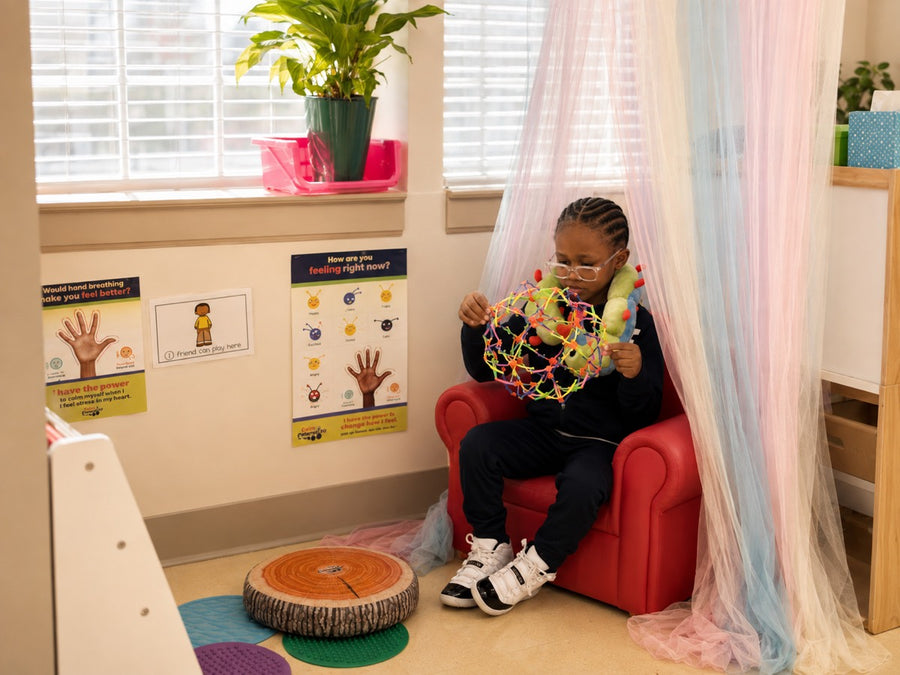
A calm corner stocked with the most interesting things in the room becomes a destination, and then it has to be rationed, and then it is a reward rather than a regulation space. Keep it dull, keep it always available, and it stays useful. How to build one.
If a child is overloading daily, leaving the room repeatedly, or the pattern is getting worse across a term, that belongs with the SENCo and, with parental consent, an occupational therapist. Environmental adjustments are worth making either way, but they are not an assessment.
When to escalate
A pattern across a fortnight is the thing a SENCO, an occupational therapist or a paediatrician can act on. Three or four dated notes about what preceded each incident are worth more than any description of the incident itself.
Chosen so that using one does not make a child visible to thirty other people.


A place in the room that is not a consequence, with the tools already in it.
Ages 3 to 12
Shop the classroom kit

Weight across the lap at the desk, without leaving the room.
Ages 4 to 12
Shop Flutter

A quiet fidget that does not need permission or a sentence.
Ages 3 to 12
Shop Calmee